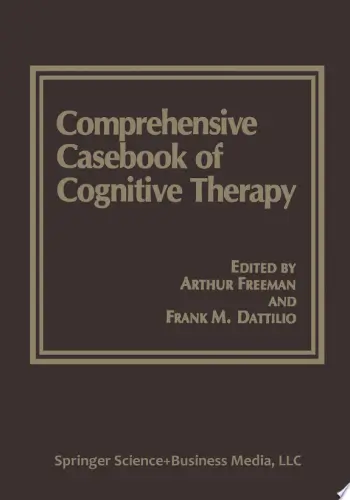
Comprehensive Casebook of Cognitive Therapy
What's it about?
Comprehensive Casebook of Cognitive Therapy offers you an in-depth exploration of cognitive therapy through real-world case studies. You'll discover practical applications of cognitive techniques, helping you understand how to effectively address various psychological issues. Each chapter provides valuable insights into treatment strategies and therapeutic relationships, enhancing your ability to apply these methods in practice. With its focus on evidence-based approaches, this book equips you with the tools to foster client growth and resilience.
About the Author
Frank M. Dattilio is a clinical psychologist known for his contributions to cognitive-behavioral therapy. His work often focuses on integrating psychotherapy with medical treatment, emphasizing family dynamics and relationship issues. Dattilio's writing is characterized by a practical, evidence-based approach, contributing significantly to the field of clinical psychology.
5 Key Ideas of Comprehensive Casebook of Cognitive Therapy
Reframing Negative Thoughts
Shift your perspective by identifying and challenging negative thought patterns to enhance emotional well-being.
Think of your mind like a photographer's lens: just as shifting the angle changes the picture, altering your thoughts reshapes your reality.
- Identifying distorted thoughts helps break negative cycles.
- Reframing fosters healthier emotional responses.
- Challenging negative thoughts can improve overall life satisfaction.
Choose one negative thought you commonly have, and practice writing down three alternative, positive interpretations.
Avoid letting the negative thought escalate by reminding yourself that thoughts are not facts and can be changed.
Embracing Cognitive Empathy
Cultivating cognitive empathy allows you to understand others' perspectives, improving relationships and reducing conflict.
Consider empathy as a mental tightrope walk: balancing your perspective with theirs enhances communication and harmony.
- Enhances connection by seeing things from another’s viewpoint.
- Reduces misunderstandings in daily interactions.
- Strengthens relationships through deeper we understanding.
Next time you disagree with someone, pause and intentionally consider their point of view before responding.
Don't confuse cognitive empathy with emotional empathy; focus on understanding rather than absorbing others' emotions.
Strengthening Belief Systems
Updating and reinforcing positive belief systems can lead to more constructive behaviors and improved self-esteem.
Imagine your beliefs as the blueprint of a house; solid foundations help it withstand the storm and thrive.
- Positive beliefs encourage constructive self-fulfilling prophecies.
- Examining and updating core beliefs can foster personal growth.
- Strong, healthy beliefs enhance resilience and decision-making.
Identify a limiting belief you hold and write a new, empowering belief to adopt instead.
Resist falling back upon ingrained negative beliefs by practicing self-awareness and challenging doubts.
Deeper knowledge. Personal growth. Unlocked.
Unlock this book's key ideas and 15M+ more. Learn with quick, impactful summaries.
Read Full SummarySign up and read for free!
Comprehensive Casebook of Cognitive Therapy Summary: Common Questions
 By Farid Asadi
“Cognitive therapy is a collaborative endeavor that empowers clients to change not only their thoughts but also their emotional reality.” This quote perfectly encapsulates the essence of Frank M. Dattilio'sComprehensive Casebook of Cognitive Therapy. The book dives deep into the practical application of cognitive therapy techniques through a variety of case studies, making it not just a theoretical exploration but a hands-on guide. Each chapter unravels different therapeutic strategies, highlighting unique client experiences that reveal how cognitive therapy transforms lives.
What had me hooked was Dattilio's ability to weave in real-life scenarios, illustrating both the successes and the challenges faced by therapists and clients. The case discussions sparked deep reflection, leaving me pondering about the complexities of the human mind. However, some concepts, particularly the detailed mechanisms of cognitive restructuring, left me scratching my head a bit; I found I needed to re-read sections to fully grasp the subtleties. The thoroughness with which he examines each case is commendable but can be a bit overwhelming.
Overall, Comprehensive Casebook of Cognitive Therapy is a valuable read for anyone interested in psychology, counseling, or even those just curious about cognitive behavioral strategies. If you enjoyed works like Judith Beck's Cognitive Therapy: Basics and Beyond, this book will surely resonate with you. I highly recommend it for its insightful case studies and practical approach to therapy.
 By Mohammad Yekta
Experience Personalized Book Summaries, Today!
Discover a new way to gain knowledge, and save time.
Sign up for our 7-day trial now.
No Credit Card Needed

Similar Books

Attention and Orienting
Peter J. Lang
The Piano Teacher
Elfriede Jelinek
The Courage To Be Disliked
Ichiro Kishimi
We Were Liars
E. Lockhart
The Art of Solution Focused Therapy
Elliott Connie, MA, LPC
The Science of Storytelling
Will Storr
No Longer Human
太宰治
Wanting
Luke Burgis
Mrs Dalloway
Virginia Woolf
The Rational Optimist
Matt RidleyTrending Summaries

Peak
Anders Ericsson
Never Split the Difference
Chris Voss
Smart Brevity
Jim VandeHei
The Psychology of Money
Morgan Housel
The First 90 Days
Michael D. Watkins
Atomic Habits
James Clear
Thinking, Fast and Slow
Daniel Kahneman
The Body Keeps the Score
Bessel van der Kolk M.D.
The Power of Regret
Daniel H. Pink
The Compound Effect
Darren HardyNew Books

The Daily Stoic 10th Anniversary Edition
Ryan Holiday
How To Talk So Little Kids Will Listen
Joanna Faber
Serpent Rising
Neven Paar
Super Mario Encyclopedia: The Official Guide to the First 30 Years
Nintendo
Make Yourself Unforgettable
Dale Carnegie Training
SCRATCH YOUR OWN ITCH: Turning Personal Needs into Purposeful Action
DR. NEERAJ TIWARI
Autobiography of a Yogi
Sri Sri Paramahansa Yogananda
Batman: The World
Various
Life in the White House
Robert P. Watson
 Sign up with Google