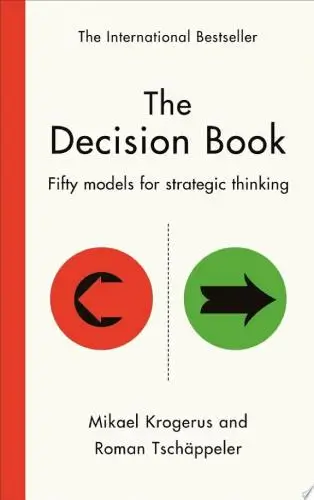
The Decision Book
Fifty models for strategic thinking
What's it about?
The Decision Book by Mikael Krogerus offers you a practical guide to making better choices in various aspects of life. It presents 19 decision-making tools that simplify complex situations, ranging from personal dilemmas to business strategies. You will learn to analyze problems using frameworks like the SWOT analysis and the Pareto principle, enhancing your ability to evaluate options effectively. Each tool is accompanied by real-world examples, making it easier for you to apply these concepts in your daily decision-making processes.
About the Author
Mikael Krogerus is a Swiss-Finnish author known for co-authoring "The Decision Book" and "The Communication Book." His work often distills complex ideas into accessible formats, using concise, practical insights. Krogerus focuses on decision-making, communication, and personal development, offering readers clear frameworks for understanding and applying these concepts.
5 Key Ideas of The Decision Book
The Eisenhower Matrix: Mastering Task Prioritization
Divide tasks into four categories—urgent and important, important but not urgent, urgent but not important, and neither—to revolutionize your time management.
Picture a cluttered desk: stacks of papers everywhere. By using the Eisenhower Matrix, it transforms into a neatly organized space where every document has its place, bringing clarity and focus.
- Increases productivity: By focusing on important tasks, you accomplish what truly matters.
- Reduces stress: Knowing what's important and urgent can eliminate feelings of being overwhelmed.
- Enhances decision-making: Offers a clear framework to quickly determine what demands your attention.
Create your own Eisenhower Matrix today by listing out your tasks and categorizing them according to importance and urgency.
Avoid confusing urgency with importance; just because something is pressing doesn't mean it's essential.
The Six Thinking Hats: Diverse Perspectives for Better Decisions
Use different 'hats' (modes of thinking) to gain a full spectrum of perspectives for more balanced decision-making.
Imagine approaching a problem as a detective who wears different disguises to see every angle of a case—each hat offers a fresh perspective.
- Encourages lateral thinking: Switching perspectives broadens your cognitive horizons.
- Prevents groupthink: Different hats assure a diversity of opinions.
- Uncovers hidden opportunities and risks: No stone goes unturned in the decision-making process.
Test the Six Thinking Hats in your next team meeting by assigning each member a different role (e.g., optimistic, critical, creative) to evaluate the decision comprehensively.
Beware of staying too long in one thinking mode; the power lies in switching hats fluidly.
The SWOT Analysis: Unearthing Insights from Strengths and Weaknesses
Conduct a SWOT analysis to unveil insights about internal strengths and weaknesses, and external opportunities and threats.
Think about a legendary ship navigating through ocean storms; its crew relies on a solid understanding of the vessel's capabilities and the weather conditions.
- Reveals strategic opportunities: Pinpoints where to direct resources for maximum gain.
- Identifies potential threats: Brings to light future obstacles and vulnerabilities.
- Clarifies strengths and weaknesses: Provides a realistic picture of your current status.
Perform a personal SWOT analysis by listing down individual strengths, weaknesses, goals (opportunities), and anxiety sources (threats) to set strategic goals.
Don't get bogged down in lengthy lists; focus on key items that genuinely impact your situation.
Deeper knowledge. Personal growth. Unlocked.
Unlock this book's key ideas and 15M+ more. Learn with quick, impactful summaries.
Read Full SummarySign up and read for free!
The Decision Book Summary: Common Questions
 By Farid Asadi
“The right decision is not always the most rational one.” This quote from The Decision Book by Mikael Krogerus resonated deeply as I navigated through its insightful pages. The book is a compact guide to various decision-making models and frameworks, perfect for anyone wrestling with choices in their professional or personal life. What hooked me were the real-life applications of each model; they provided tangible ways to analyze situations, making the concepts feel practical and relevant.
Particularly intriguing was the '10/10/10 Rule', which suggests weighing the consequences of a decision over ten minutes, ten months, and ten years. This simple yet profound technique left me reflecting on my daily choices. However, I found some models a bit complex and, at times, overly analytical for decisions that should be intuitive. It left me wondering about the balance between rationality and instinct in decision-making.
Overall, The Decision Book is a valuable resource for anyone interested in improving their decision-making skills. It’s reminiscent of Thinking, Fast and Slow by Daniel Kahneman, but more concise and accessible. I highly recommend it for a quick yet impactful read that can reshape how you think about the choices you make.
 By Mohammad Yekta
Experience Personalized Book Summaries, Today!
Discover a new way to gain knowledge, and save time.
Sign up for our 7-day trial now.
No Credit Card Needed
Similar Books

This is Going to Hurt
Adam Kay
The ^AOxford Handbook of Job Loss and Job Search
Ute-Christine Klehe PhD
Job Interviews For Dummies®
Joyce Lain Kennedy
Job Interviews In A Week
Alison Straw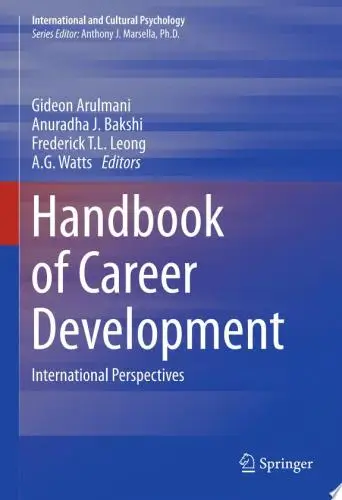
Handbook of Career Development
Gideon Arulmani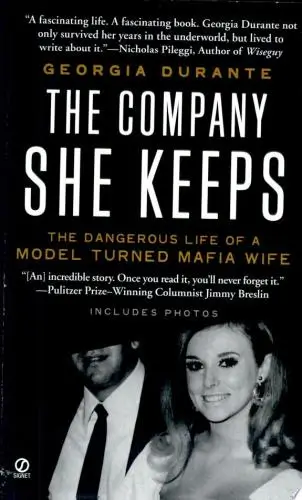
The Company She Keeps
Georgia Durante
The Millionaire Fastlane
MJ DeMarco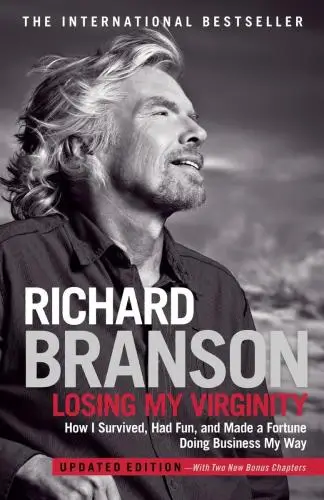
Losing My Virginity
Richard Branson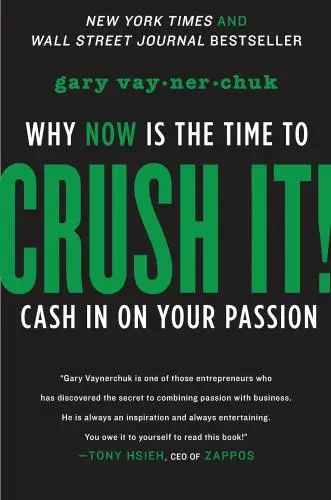
Crush It!
Gary Vaynerchuk
The Go-Giver
Bob BurgTrending Summaries
Peak
Anders Ericsson
Never Split the Difference
Chris Voss
Smart Brevity
Jim VandeHei
The Psychology of Money
Morgan Housel
The First 90 Days
Michael D. Watkins
Atomic Habits
James Clear
Thinking, Fast and Slow
Daniel Kahneman
The Body Keeps the Score
Bessel van der Kolk M.D.
The Power of Regret
Daniel H. Pink
The Compound Effect
Darren HardyNew Books
The Daily Stoic 10th Anniversary Edition
Ryan Holiday
How To Talk So Little Kids Will Listen
Joanna Faber
Serpent Rising
Neven Paar
Super Mario Encyclopedia: The Official Guide to the First 30 Years
Nintendo
Make Yourself Unforgettable
Dale Carnegie Training
SCRATCH YOUR OWN ITCH: Turning Personal Needs into Purposeful Action
DR. NEERAJ TIWARI
Batman: The World
Various
Autobiography of a Yogi
Sri Sri Paramahansa Yogananda
Life in the White House
Robert P. Watson

 Sign up with Google