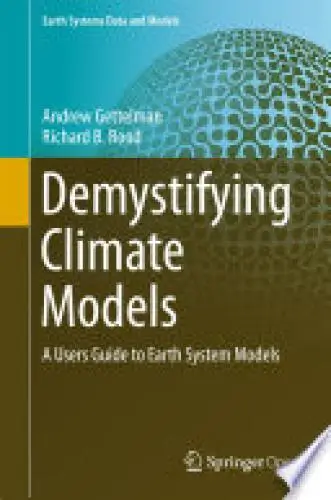
Demystifying Climate Models
A Users Guide to Earth System Models
What's it about?
Demystifying Climate Models offers you an insightful exploration into the workings of climate models that shape our understanding of global warming and climate change. You'll learn about the fundamental principles behind these models, how they simulate atmospheric conditions, and their role in predicting future scenarios. The book breaks down complex concepts into accessible explanations, helping you appreciate the science behind climate projections. By the end, you’ll gain a clearer perspective on how these models inform policy and public awareness around climate issues.
About the Author
Andrew Gettelman is a prominent climate scientist known for his contributions to atmospheric sciences, particularly in climate modeling and cloud processes. His work often explores the interactions between climate systems and human activity, offering a clear perspective on environmental impacts. His writing combines rigorous data analysis with accessible scientific communication.
5 Key Ideas of Demystifying Climate Models
Embrace Climate Complexity
Understanding the intricacies of climate models allows us to better anticipate and adapt to environmental changes.
Think of climate models like the weatherman's patterns but on a global scale—predicting tomorrow's storms and next year's droughts to give us the blueprint for preparation.
- Climate models synthesize massive datasets to reveal long-term trends that individual observations can't capture.
- They empower policymakers with scenarios that highlight the potential impacts of decisions on the environment.
- Understanding these models demystifies the future, making it less unpredictable and more manageable.
Read a summary or watch a video about how climate models predict climate changes and note one key prediction that could impact your area.
Avoid assuming climate models are crystal balls; they're tools that outline possibilities, not certainties.
Every Action Counts
Small, informed decisions in daily life contribute significantly to the larger environmental impact.
Like raindrops filling a bucket, individual actions—like choosing reusable over disposable—add up to make a grand difference.
- Even minor adjustments in our consumption or habits, when collectively adopted, lead to substantial environmental benefits.
- Climate models illustrate the cumulative impact of collective actions, giving credibility to personal commitments.
- Promoting sustainable choices in personal and communal spaces creates a ripple effect toward positive change.
Swap one single-use item (like plastic bags) for a reusable option today.
Don't underestimate the power of small changes; dismissing them as insignificant undermines collective potential.
The Power of Visualization
Utilizing climate models as visual tools turns abstract data into compelling stories that can inspire action.
Imagine painting a mural that captures past, present, and future narratives, guiding communities on journeys of change.
- Visual representations of data make complex climate concepts accessible and relatable.
- They bridge the gap between scientific understanding and public consciousness, driving informed action.
- Graphics derived from models can sway opinions and spark policy discussions grounded in evidence.
Find a visual representation of climate data and share it with your community on social media, sparking a conversation.
Dismissing visuals as mere illustrations can lead to underestimating their influence in communicating science.
Deeper knowledge. Personal growth. Unlocked.
Unlock this book's key ideas and 15M+ more. Learn with quick, impactful summaries.
Read Full SummarySign up and read for free!
Demystifying Climate Models Summary: Common Questions
 By Farid Asadi
“Climate models are not crystal balls; they are complex, evolving tools that help us understand our changing world.”
I just finished reading Demystifying Climate Models by Andrew Gettelman, and it really opened my eyes to the complexities behind climate modeling. Gettelman expertly breaks down how these models work, illustrating their strengths and limitations. The way he explains the intricacies of atmospheric processes and the role of feedback mechanisms—like cloud formation—was particularly engaging. It left me pondering how even small changes can have significant impacts on our climate predictions.
However, there were moments that had me scratching my head, especially when delving into the mathematical equations that underpin these models. Gettelman does a great job of attempting to simplify these concepts, but the technical depth can be overwhelming for those of us not well-versed in science. Despite this, I appreciated the author’s efforts in making the material accessible while still retaining intellectual rigor, similar to how Samantha Montano approached disaster preparedness in her book, Disasters by the Numbers.
Overall, I highly recommend Demystifying Climate Models for anyone interested in understanding climate science at a deeper level. It's a thought-provoking read that balances complexity and clarity, making it a valuable addition to the bookshelf of both experts and novices alike.
 By Mohammad Yekta
Experience Personalized Book Summaries, Today!
Discover a new way to gain knowledge, and save time.
Sign up for our 7-day trial now.
No Credit Card Needed
Similar Books

Mathematics for Machine Learning
Marc Peter Deisenroth
Clinical Microbiology
Parslow
Medical Laboratory Science Review
Robert R Harr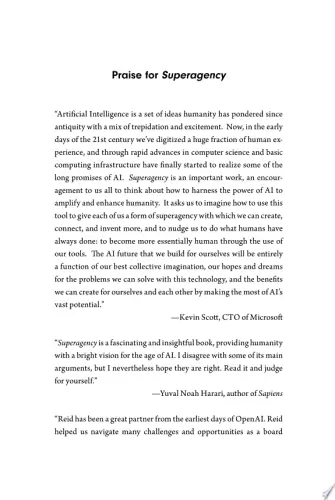
Superagency
Reid Hoffman
Artificial Intelligence
Nicola Acocella
Frankenstein
Mary Shelley
The Circle
Dave Eggers
Roitt's Essential Immunology
Peter J. Delves
Laws of UX
Jon Yablonski
Structures
J. GordonTrending Summaries

Peak
Anders Ericsson
Never Split the Difference
Chris Voss
Smart Brevity
Jim VandeHei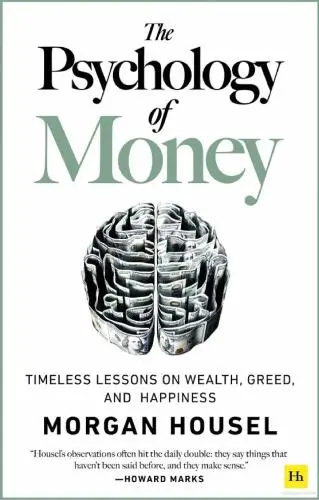
The Psychology of Money
Morgan Housel
The First 90 Days
Michael D. Watkins
Atomic Habits
James Clear
Thinking, Fast and Slow
Daniel Kahneman
The Body Keeps the Score
Bessel van der Kolk M.D.
The Power of Regret
Daniel H. Pink
The Compound Effect
Darren HardyNew Books

How To Talk So Little Kids Will Listen
Joanna Faber
Serpent Rising
Neven Paar
Super Mario Encyclopedia: The Official Guide to the First 30 Years
Nintendo
Make Yourself Unforgettable
Dale Carnegie Training
SCRATCH YOUR OWN ITCH: Turning Personal Needs into Purposeful Action
DR. NEERAJ TIWARI
Autobiography of a Yogi
Sri Sri Paramahansa Yogananda
Batman: The World
Various
Life in the White House
Robert P. Watson
Attention and Orienting
Peter J. Lang

 Sign up with Google